

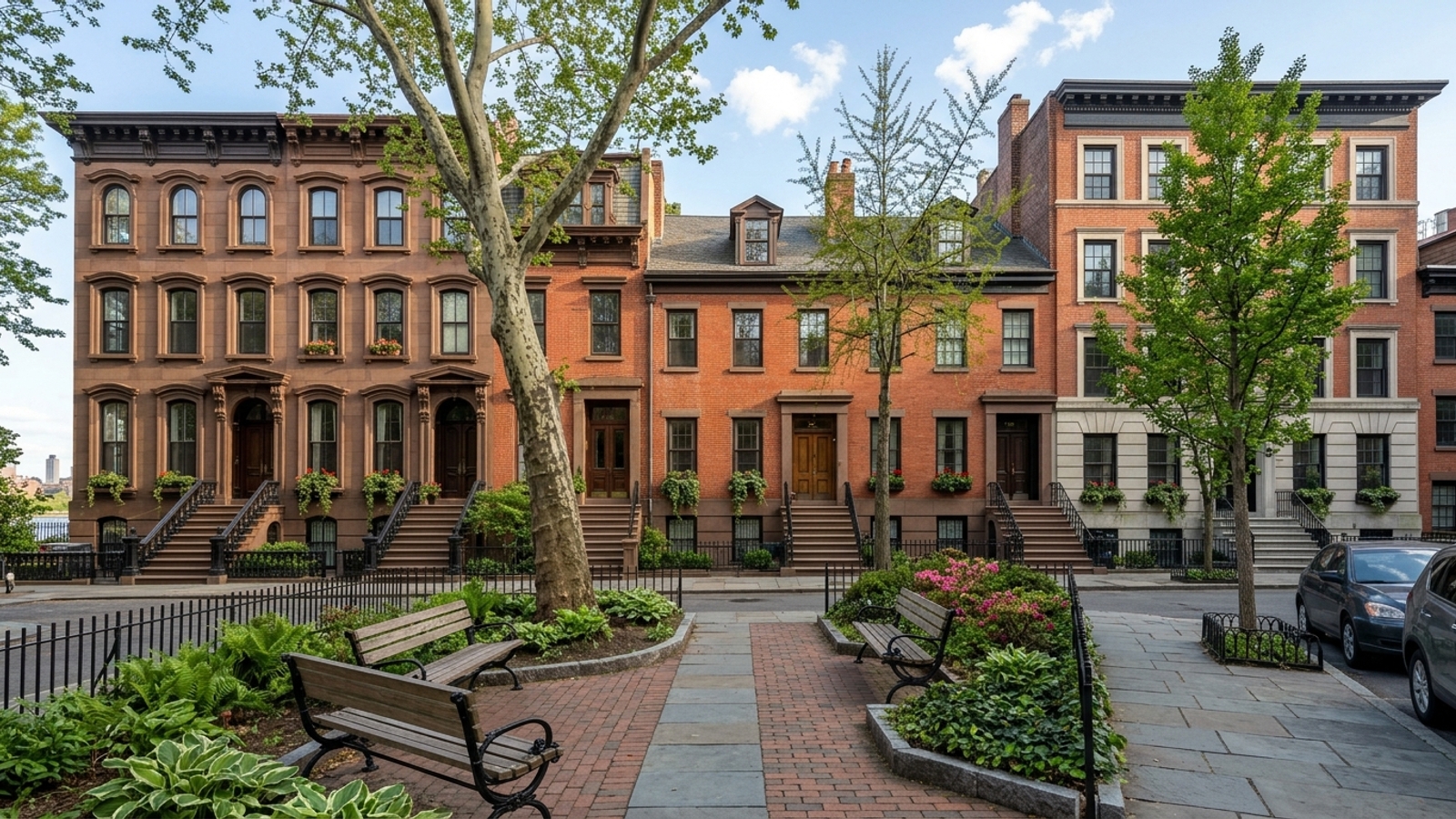
The Brooklyn Heights housing market opens with a headline price above $1.8 million that surprises many shoppers new to the neighborhood. Look up the average cost of a home in Brooklyn Heights, NY, and you’ll find a median hovering above $1.8 million.
That number tells only part of the story. What people pay depends on the property type they buy and the closing costs stacked on top of the purchase price. The gap between the broad median and the condo median is the single most useful thing to understand before you set a budget.
Key Takeaway
For most budgets, start with a condo sized to the space you need. If you need more room than a typical condo offers, plan around the all-homes median instead.
Who This Guide Is For
You are setting a budget to buy in Brooklyn Heights and need to know what a typical home costs, including the taxes and monthly charges on top of the price.
Typical Home Prices in Brooklyn Heights
The $1.81 million figure you’ll see for Brooklyn Heights reflects a market where condos dominate sales. Condos were 62 of the 69 sales in the 90 days ending September 30, 2026, at a median of $1.4 million, flat on the year and at the same per-square-foot rate as the market overall. Your budget is a question of how many square feet you need. Flat prices have not meant discounts either: 40.7% of condos still sold above list.
The gap between the $1,811,992 median for all homes and the condo median is about $412,000. Real estate data reports medians rather than means to prevent a single multi-million dollar townhouse from skewing the typical price upward. Both segments sell at the same price per square foot, so the price difference comes down entirely to size. Benchmark against the condo median unless you need the larger footprint that non-condo properties offer.
Condo Prices in Brooklyn Heights
Condos are the primary market here, not a small sub-segment. Roughly nine out of ten homes that sold in Brooklyn Heights over the summer quarter were condos, so the headline all-homes median mostly reflects them anyway. Because they trade at the same per-foot price as the market overall, their lower median reflects smaller homes, not cheaper space.
The median price is only the entry ticket. Monthly common charges and taxes come on top, and sales records don’t report them, so every listing needs its own numbers run.
Prices for Homes Other than Condos
Only 7 of the 69 sales were something other than a condo, a property type the available data doesn’t break out specifically. Those few sales lift the all-homes median well above the condo figure, representing a small, pricier slice of the market.
With only 7 sales behind it, this slice can’t be priced reliably from aggregate data alone. One large sale can swing the all-homes median, so if you’re shopping beyond condos, ask for recent comparable sales on the same blocks rather than leaning on the headline figure.
How Much Space Your Budget Buys
At that median price per square foot, a budget near the condo median buys roughly 910 square feet. Stretching to the $1.81 million all-homes median buys roughly 1,180 square feet, while a $1 million budget secures about 650 square feet. These are illustrations only: building amenities, floor level, views, light, and condition all move real prices above or below this median baseline.
The extra 270 square feet between the two medians costs about $412,000. Before comparing price per square foot across listings, confirm how each one’s square footage was measured and ask for a floor plan with dimensions.
Brooklyn Heights Housing Market Trends
Prices for all homes rose 4.5% year-over-year in the 90 days ending September 30, 2026, while condo prices remained completely flat. That gain rests entirely on the 7 non-condo sales, making it a small-sample direction rather than a locked-in trend.
Flat condo prices have not produced discounts. Over 40% of condos sold above list price, and the overall sale-to-list ratio was above asking with just 2.6 months of supply. On a well-priced unit, plan to pay asking or more. The median days on market is 35, meaning a typical deal goes to contract in about five weeks, so financing approval should be in hand before you bid. You can review longer-term trends on the housing market page.
Costs to Budget for on Top of the Price
The list price is only the starting point for a Brooklyn Heights purchase. Closing costs and monthly carrying charges add substantially to your total outlay and scale directly with the purchase price.
Because the neighborhood’s home values are high, buyers frequently trigger additional taxes and exceed standard loan limits. Account for these specific costs before making an offer.
Down Payment and Financing
For 2026, the FHFA conforming loan limit for Kings County, NY, is $1,209,750 for a one-unit property. At the condo median, a typical purchase requires a jumbo loan or a larger down payment. As of October 29, 2026, Freddie Mac reported the 30-year fixed-rate mortgage averaging 7.24%.
Jumbo loans and co-op boards both tend to ask for more cash and more documentation, so the down payment you plan for may need to be larger than the price alone suggests. Ask the lender and, for a co-op, the managing agent for exact requirements.
New York Mansion Tax
New York’s mansion tax applies to NYC residential sales of $1,000,000 or more. It uses a 1% statewide base tax plus a progressive NYC-only supplemental tax. At the condo median, the 1.00% tax rate adds $14,000 to closing costs. At Brooklyn Heights prices, almost every purchase crosses the threshold.
It’s paid in cash at closing and generally can’t be financed into the loan. Confirm the exact amount with your attorney before you get there.
Mortgage Recording Tax
The NYC Department of Finance charges a mortgage recording tax on condo and house loans. The rate is 1.125% for residential mortgages of $500,000 or more. On a typical 80% loan for that median condo price ($1,120,000), this tax adds $12,600 to your closing costs.
Whether an apartment is a condo or a co-op can shift your closing costs by thousands of dollars through this tax alone, since co-op share loans generally avoid it. The tax scales with the loan amount, so borrowing more raises this bill. Ask your attorney for a closing cost estimate that includes it.
Common Charges, Maintenance and Property Taxes
Condo owners pay monthly common charges plus their own property tax bill, while co-op maintenance usually bundles the building’s taxes. The FY2026 NYC property tax rate for Class 2 residential properties, which includes condos and co-ops, is 12.439%.
These monthly costs can change what you can afford as much as the purchase price does, and they vary building by building. Ask the listing agent for the current common charges or maintenance, the latest tax bill, and any planned assessments before making an offer. You can compare these figures alongside other budget items on the cost of living and monthly budget page, or check the utilities page for water costs. Randy Baruh at Compass can pull recent sales and charges for a specific building.
How to Decide What to Budget
Start with square footage. If you don’t need more than about 900 square feet, the condo median is your benchmark. If you do, use the space-per-budget illustration and plan closer to the all-homes median.
Next, decide whether you can pay at or above asking on a well-priced unit. If that’s a stretch, review the housing market trends before you set a ceiling. Then sort out the property type: condo or co-op changes your down payment, your board approval process, and whether the mortgage recording tax applies. If your price is $1 million or more, the mansion tax applies regardless.
To find the lowest realistic entry price in Brooklyn Heights, start with condos benchmarked against the condo median, because you aren’t paying a lower rate per foot, just buying less space. If you want roughly 1,200 square feet or more, start with a budget near the all-homes median. If you want to keep closing cash lower, compare condo and co-op listings at the same price with closing costs included. If you want to avoid a bidding situation, look at listings that have been on the market longer than the 35-day median.
At a Glance
- Median sale price, all homes: $1,811,992 (90 days ending Sept. 30, 2026; 69 sales)
- Median sale price, condos: $1,400,000 (90 days ending Sept. 30, 2026; 62 sales)
- Year-over-year change in median sale price: +4.5% for all homes, 0% for condos (90 days ending Sept. 30, 2026)
- Median price per square foot: $1,538 for all homes and $1,538 for condos (90 days ending Sept. 30, 2026)
- Median days on market: 35 for all homes and 35 for condos (90 days ending Sept. 30, 2026)
- Sale-to-list price ratio: 100.2% for all homes and 100.2% for condos (90 days ending Sept. 30, 2026)
- Share sold above list price: 39.6% of all homes, 40.7% of condos (90 days ending Sept. 30, 2026)
- Months of supply: 2.9 for all homes, 2.6 for condos (90 days ending Sept. 30, 2026)
- Homes for sale (inventory): 66 total, 53 condos (90 days ending Sept. 30, 2026)
- Source line under the list: Redfin data. Types with fewer than 10 sales are not broken out.
Brooklyn Heights Home Price FAQs
How Does the Cost of a Home in Brooklyn Heights Compare with the Average House in New York?
Brooklyn Heights condos trade at nearly three times the statewide typical home price. The statewide median sale price for single-family homes in New York State was $475,000 in June 2026, up 8.0% from the prior year.
What Is a Reasonable Price per Square Foot in Brooklyn Heights?
The median price per square foot is a reasonable benchmark. To find the exact rate for a specific unit, divide the asking price by its measured square footage and compare it with recent sales in the same building. Co-op listings sometimes omit square footage, so request a floor plan with dimensions.
What Salary Do You Need to Buy a Home in Brooklyn Heights?
Subtract your down payment from the purchase price, then calculate the monthly principal and interest using a current rate, such as the 7.24% average for a 30-year fixed mortgage as of October 29, 2026. Add monthly common charges and taxes, then apply standard debt-to-income guidelines to see the required salary. Confirm your specific income requirements with a lender, and review the cost of living page for general NYC budget questions.
Is Brooklyn Heights Expensive Compared with the Rest of Brooklyn?
Yes, Brooklyn Heights is generally more expensive than the borough as a whole. You can view the full price comparison with Brooklyn overall on the neighborhood comparison page.
Are Co-Ops Cheaper than Condos in Brooklyn Heights?
Available market data covers condos and all homes but doesn’t break out co-ops separately, so a direct median comparison isn’t available. Co-op share loans generally avoid the mortgage recording tax, though boards may require more cash down. Ask for recent sales in the specific building to compare actual costs.
Does Brooklyn Heights Flood?
Flood exposure varies by elevation and block. Check the official NYC Flood Hazard Mapper to see FEMA flood zones for specific addresses. Flood insurance may be required or advisable in mapped zones, which adds to your monthly costs. Look up the exact address and get an insurance quote before signing a contract.
How Much Does It Cost to Build a House in Brooklyn Heights?
Brooklyn Heights is New York City’s first designated historic district, meaning any exterior work visible from the street requires Landmarks Preservation Commission review and approval before a permit can be filed. That approval process shapes both the cost and the timeline of new construction. Because build costs vary widely based on the project, get estimates from an architect experienced with LPC filings.
What County Is Brooklyn Heights In?
Brooklyn Heights is in Kings County, which shares the same boundaries as the borough of Brooklyn. Property taxes here are set by the NYC Department of Finance, with a FY2026 rate of 12.439% for Class 2 residential properties.
Sources
- Redfin: Data Center
- Alpine Bank: Conforming Loan Limits New York
- Freddie Mac: Primary Mortgage Market Survey
- Benjamin Taylor: Understanding the New York State Mansion Tax
- NYC Department of Finance: Mortgage Recording Tax Report
- Help New York: NYC Property Tax Classes 1-4 Explained FY2026
- NYSAR: New York Home Prices Set Record
- NYC Department of City Planning: Flood Hazard Mapper
- Brooklyn Heights Association: Historic District Designation