

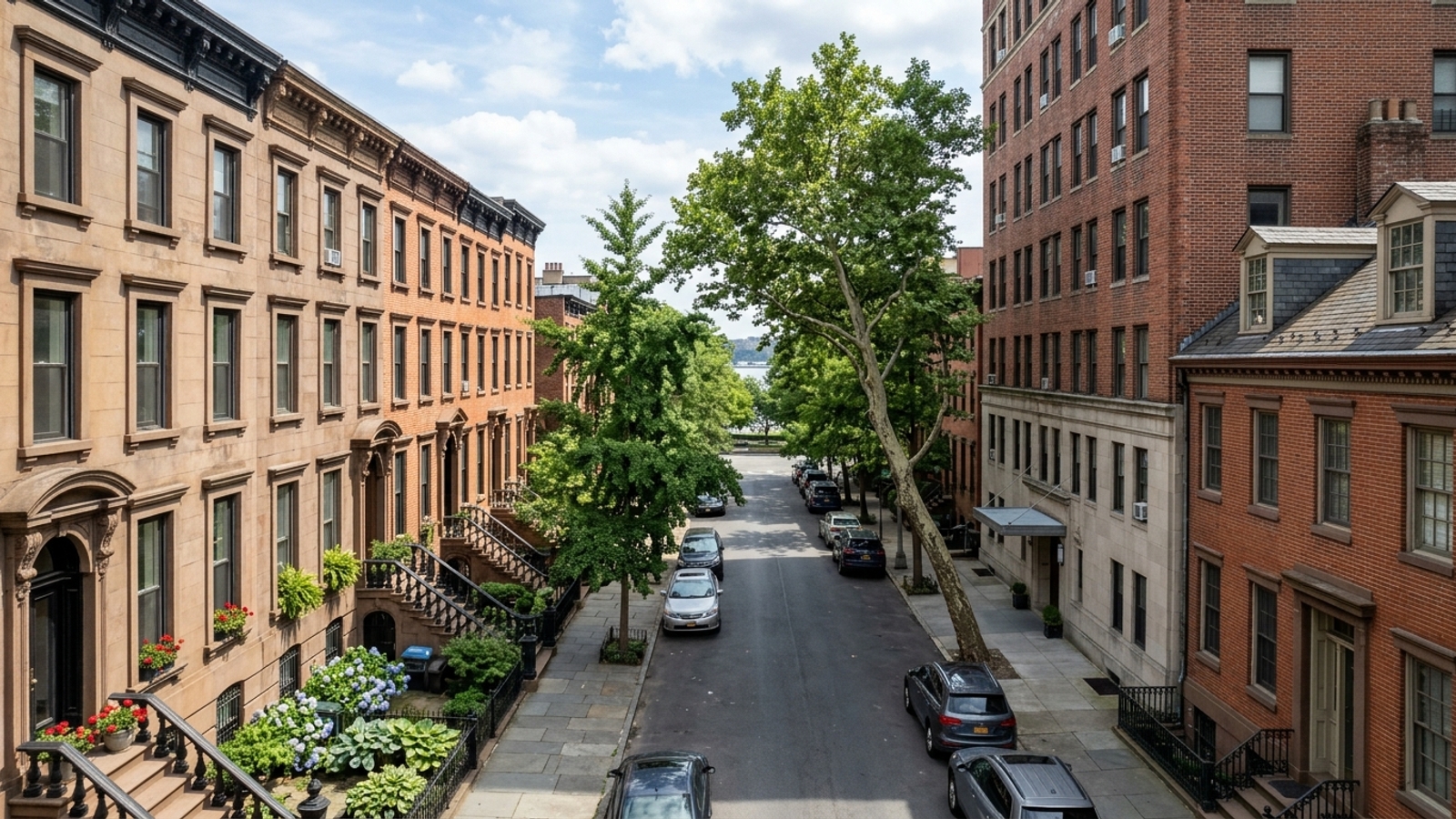
Buyers looking at apartments here notice the monthly carrying cost gap almost immediately. The monthly charge attached to a unit sets your baseline living expenses for as long as you own it, so it deserves the same scrutiny as the purchase price.
Key Takeaway
HOA fees in Brooklyn Heights, called common charges in NYC condos, range from the high hundreds to several thousand dollars a month across recent listings at named buildings. The building you pick will move your carrying cost more than the price you negotiate in a market where condo prices are flat and many sell above list. For the lowest monthly bill, look at smaller pre-war buildings in the historic core. Buyers wanting full service should compare Brooklyn Bridge Park towers on charges plus taxes.
Who This Guide Is For
You are weighing a Brooklyn Heights condo or co-op and need to work out what the monthly charge will add to your housing cost before you make an offer.
How Much Are HOA Fees in Brooklyn Heights?
The monthly charge here varies far more between buildings than condo prices are moving. No official neighborhood-wide average fee exists, so the only useful comparison is building by building. Sourced charges at the named buildings profiled below differ more than fivefold, and what each charge includes differs too.
Common Charges vs Co-Op Maintenance
In NYC, an “HOA fee” usually means condo common charges, which cover building operations, while the condo owner pays property tax separately. Co-op maintenance bundles the building’s property taxes and any underlying mortgage into one monthly bill. Many apartments in Brooklyn Heights are co-ops, so the same monthly figure can represent a different set of expenses. If you set a co-op’s maintenance next to a condo’s common charges without adding the condo owner’s tax bill, the condo will look cheaper than it is.
HOA Fees at Named Brooklyn Heights Buildings
Full-service waterfront towers carry the highest fees, and smaller pre-war buildings in the historic core run leaner. Each fee below is one unit’s charge, not a building-wide average. Charges scale with the size of the apartment or the owner’s share of the building. FHA status is unconfirmed for every building on this page, so check HUD’s FHA condominium approval list for any building you consider.
Quay Tower
A single Quay Tower unit carried a monthly charge of about $3,608, per a listing that sold November 26, 2025. That is the highest sourced charge on this page. The fee covers building operations including a full-time doorman and concierge, a fitness center, a rooftop deck, and lounges. The listing does not say whether ground rent or PILOT is inside the figure, so ask before comparing it with a building whose owners pay property tax separately.
Pierhouse at Brooklyn Bridge Park
At Pierhouse, the monthly charge includes ground rent and PILOT under the Brooklyn Bridge Park leasehold, so it is not directly comparable to a standard condo’s common charges. The Brooklyn Bridge Park Corporation relies on these Payments in Lieu of Taxes from park-adjacent condominium developments to fund the park’s maintenance and operations. The fee also covers a 24-hour attended lobby, a fitness center and yoga studio, a resident lounge, a playroom, a pet spa, and bike storage.
No fee figure from the last 12 months is on file. Ask the listing agent for the current charge, the ground lease terms, and how the PILOT portion can rise over time.
One Brooklyn Bridge Park
One Brooklyn Bridge Park is a full-service doorman and concierge condominium. Per a current listing, its common charges help pay for a gym, a playroom, and a residents’ screening room. No fee figure from the last 12 months is on file, and the listing leaves out whether PILOT is billed inside the charge or separately. Get both answers before comparing it with Quay Tower or Pierhouse.
56 Court Street
56 Court Street is a Gothic-style pre-war elevator building. Per a current listing, its charges cover video security, a shared laundry room on the second floor, and bike storage. The trade is fewer staff and amenities in exchange for a typically leaner operating budget. The figure on file is more than 12 months old, so ask the listing or managing agent for the current monthly charge and the date of the last facade inspection.
132 Remsen Street
A current listing at 132 Remsen Street, dated June 27, 2026, shows a monthly charge of about $688. That is the lowest sourced charge on this page, for a building in the historic core. The listing does not say what that charge covers, or whether it is condo common charges or co-op maintenance, so ask before treating it as the cheap option.
What the Fee Gap Costs over Ten Years
The difference between the Quay Tower and 132 Remsen Street charges is $2,920 a month, or $35,040 a year. Over ten years, that adds up to $350,400 before any increases. That total is roughly a quarter of the $1,400,000 median Brooklyn Heights condo sale price.
The Annual and Ten-Year Difference
This math is an illustration, not a quote. The two units differ in size and type, the calculation assumes charges never rise, and it ignores what each charge does or does not include. Even so, the choice of building can cost as much as a meaningful slice of the purchase price.
Adding Property Taxes Back In
The fair comparison is always the charge plus the tax. Pull the specific unit’s property tax bill with the NYC Department of Finance’s bill lookup tool and add it to the common charge. Co-op maintenance and PILOT-structured park buildings already fold that cost in. If a newer building’s tax bill is low because of an abatement (see below), today’s charge-plus-tax total will step up when it expires.
What Drives Common Charges Up or Down
Monthly fees reflect the actual cost of running the building, paying the staff, and maintaining the structure. You can check each of the drivers below on any building you consider.
Building Staff and Amenities
Doormen, concierges, porters, and supers are typically the biggest budget line for any property. Gyms, rooftop decks, playrooms, and screening rooms add continuous maintenance and staffing costs on top, which is why the full-service park towers sit at the top of the range. You pay for every amenity whether you use it or not, and the charge has to fund periodic renovation of those spaces.
Landmark Rules and Facade Upkeep in Older Buildings
Brooklyn Heights became New York City’s first designated historic district in 1965, so exterior work on any building here requires Landmarks approval. Buildings over six stories must also pass periodic facade inspections under the NYC Facade Inspection Safety Program. A low charge in an older building isn’t always a bargain: it can mean deferred facade or roof work that later arrives as a special assessment.
Local Law 97 and Energy Costs
Local Law 97 sets annual emissions caps for most NYC buildings over 25,000 square feet. Buildings that exceed their limit face a penalty of $268 per metric ton of CO2-equivalent over the cap. Compliance upgrades or penalties reach owners through higher monthly charges or assessments, so ask the managing agent for the building’s Local Law 97 status and compliance plan. Heating and fuel costs also take up a large part of many building budgets.
Tax Abatements and PILOT Payments
Newer condos may carry a 421-a abatement that lowers owners’ tax bills for a set period, and park buildings’ PILOT obligations can change on their own schedule. Both affect the charge-plus-tax total, not just the base charge. Ask whether the building has a tax abatement and when it ends, because the owner’s monthly cost can step up even if the common charge stays flat.
How to Tell If a Monthly Charge Is Too High
A high fee in a well-run building can be a better deal than a low fee in a building with failing infrastructure.
Read the Budget and Reserve Fund
Ask for two years of financial statements and the current reserve balance. Under Fannie Mae rules, a condo association’s annual budget must allocate at least 10% of its budgeted assessment income to replacement reserves, unless a qualifying reserve study justifies a different allocation. A charge that looks low can mean an underfunded reserve, which is the most common route to a large special assessment.
Check for Special Assessments
Read recent board minutes to see what repairs are being discussed. Ask the managing agent about any current, approved, or planned special assessments, and ask specifically whether facade, roof, or Local Law 97 work is scheduled. Assessments rarely appear in a listing’s monthly figure, and a buyer can inherit one approved just before closing.
Compare the Charge to the Unit’s Size
Divide the monthly charge by the unit’s square footage to compare buildings on a like-for-like basis. NYC listing square footage is not standardized, so confirm it against the floor plan or offering plan before relying on that math.
Confirm What the Charge Leaves Out
Ask whether heat, hot water, gas, electricity, and property taxes are included or billed separately. Two buildings with similar charges can differ by hundreds of dollars a month once separately billed costs are added. Put any electricity and gas the building doesn’t cover into your utilities estimate before comparing.
One-Time Costs Beyond the Monthly Charge
Buying into a condo or co-op often triggers several one-time building fees that can add thousands of dollars to your cash to close. The offering plan or proprietary lease sets the exact terms.
Working Capital Contribution
New-development and some resale condos collect an upfront contribution, often a set number of months of common charges. It scales with the monthly charge, so a high-charge building means a bigger check, due in cash at closing on top of the down payment.
Flip Taxes in Co-Ops
Many co-ops charge a transfer fee called a flip tax when a unit sells, set in the proprietary lease or bylaws. It is usually the seller’s cost when selling a home. However, who pays can be negotiated and some buildings put it on the buyer, so check the documents before you bid.
Move-In Fees and Deposits
Buildings commonly charge move fees and hold refundable damage deposits under their house rules, so ask the managing agent for the schedule. Deposits can be partly withheld for elevator or hallway damage.
How to Choose a Building by Its Monthly Charge
Four questions narrow the field:
- Do you need a staffed lobby and amenities, or would you trade them for a much lower monthly bill? Start with the named buildings above, then the staff and amenities section.
- Does the charge you were quoted already include property taxes or PILOT, or will a tax bill come on top? See the Pierhouse profile and the property tax section.
- Is the building facing big upcoming costs that could raise charges or trigger an assessment? See what drives charges up and the special assessments check.
- How much cash will you have left after the down payment for one-time building costs? See the one-time costs section.
If you want the lowest sourced monthly charge on this page, start with 132 Remsen Street, but confirm what that charge covers. If you want a pre-war elevator building with basic shared services instead of a full amenity package, 56 Court Street is a solid option because its charges cover video security, a second-floor laundry room, and bike storage.
If you want a staffed lobby and amenities with a monthly figure closer to all-in, start with Pierhouse at Brooklyn Bridge Park, because its charge includes ground rent and PILOT. If you want a benchmark for what a full-service waterfront tower can cost per month, look at Quay Tower, because it is the only full-service building here with a sourced charge.
Before you bid, check the charge-plus-tax total against three things: your full cost of living in Brooklyn Heights, the current Brooklyn Heights housing market, and the steps of buying a home in Brooklyn Heights. If you need help running the numbers on a specific unit, reach out and I can pull the property’s financial history for you.
At a Glance
- Condo median sale price: $1,400,000, 0% YoY (Redfin, 90 days ending 2026-09-30)
- All homes median sale price: $1,811,992, up 4.5% YoY (Redfin, 90 days ending 2026-09-30)
- Condo median price per square foot: $1,538 (Redfin, 90 days ending 2026-09-30); the all-homes figure is also $1,538
- Condo homes sold: 62; all homes sold: 69 (Redfin, 90 days ending 2026-09-30)
- Condo median days on market: 35 (Redfin, 90 days ending 2026-09-30)
- Condo sale-to-list ratio: 100.2% (Redfin, 90 days ending 2026-09-30)
- Condos sold above list: 40.7%; all homes: 39.6% (Redfin, 90 days ending 2026-09-30)
- Condo months of supply: 2.6; all homes: 2.9 (Redfin, 90 days ending 2026-09-30)
- Condo inventory: 53 listings; all homes: 66 (Redfin, 90 days ending 2026-09-30)
Brooklyn Heights HOA Fee FAQs
What Is the Average Monthly HOA Fee in NYC?
No official citywide average is published for New York City condo common charges. The named Brooklyn Heights buildings above are the best local reference points.
Is a $600 HOA Fee Too Much in Brooklyn Heights?
It depends on what the charge covers and whether taxes come on top. 132 Remsen Street, the lowest named example on this page, sits just above that level, so confirm the inclusions and add the unit’s tax bill before comparing totals.
How Expensive Is It to Live in Brooklyn Heights?
The median sale price for all homes is $1,811,992, up 4.5% year over year (Redfin, 90 days ending 2026-09-30). Monthly charges and taxes come on top of your mortgage payment.
Is Brooklyn Heights the Most Expensive Neighborhood in Brooklyn?
Compared with Brooklyn prices overall, Brooklyn Heights consistently ranks among the highest-priced areas in the borough based on home values.
Is Brooklyn Heights a Flood Zone?
Certain parts of the neighborhood fall in mapped flood zones, especially the waterfront Brooklyn Bridge Park parcels. A building’s flood exposure can raise its master insurance, which flows into your monthly charge, so ask the board for the building’s flood zone and insurance line.
Are HOA Fees in Brooklyn Heights Paid Monthly or Yearly?
NYC condo common charges and co-op maintenance are typically billed monthly, and the named listings on this page all quote charges per month.
Do Common Charges Count Toward Mortgage Approval?
Yes. Fannie Mae’s Desktop Underwriter counts the mortgage payment plus taxes, insurance, and association dues in your debt-to-income ratio. Co-op boards often set their own stricter ratios, so ask the managing agent what the board requires.
How Often Do Common Charges Go Up in Brooklyn Heights Buildings?
It depends on the building’s finances and upcoming projects. Ask for five years of budgets and the history of increases and assessments, and watch for the facade, Local Law 97 and abatement triggers described above.
Sources
- Redfin: Data Center
- Compass listing #RLS10975416 (active null)
- SERHANT listing #RLS10983393 (sold 2025-11-26)
- Douglas Elliman listing #RLS20013681 (active 2025-04-02)
- Corcoran listing #RLS20083886 (active null)
- Compass listing #RLS20100359 (active 2026-06-27)
- Brooklyn Bridge Park Corporation: History
- NYC Accelerator: Local Law 97
- Brooklyn Heights Association: Neighborhood
- Fannie Mae: Full Review Process Eligibility Requirements
- Fannie Mae: DTI Ratio Calculation Questions