

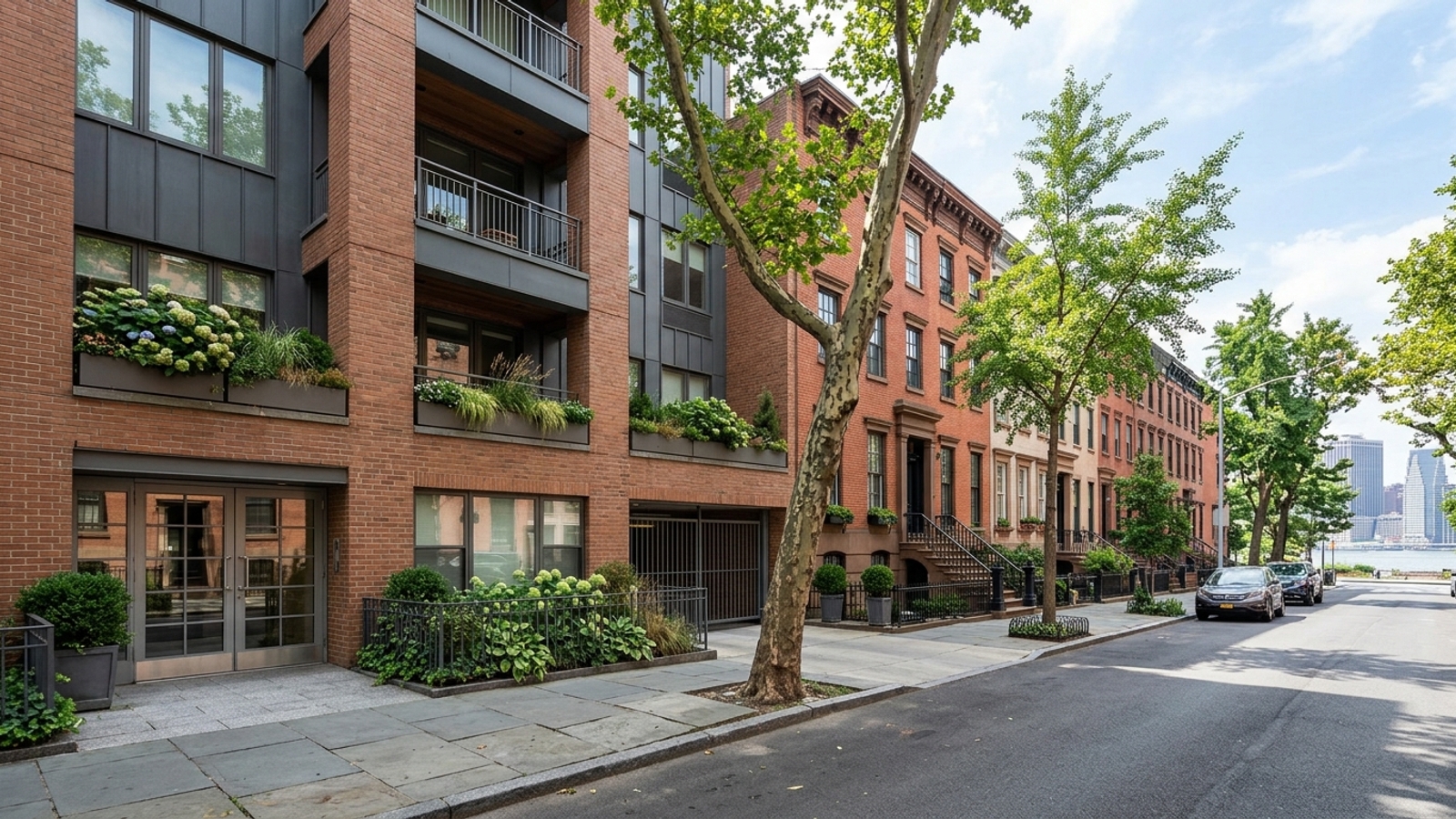
Brooklyn Heights has almost no ground-up new development because it’s a designated historic district. The real choice for buyers is between a handful of older building conversions, a few newer buildings along Brooklyn Bridge Park, and the resale condos that make up most of the market.
Key Takeaway
New development in Brooklyn Heights means a short list of conversions and Brooklyn Bridge Park buildings, not tracts of new homes, because the neighborhood is a landmarked historic district. If you want newer systems and park access, start with the buildings along Brooklyn Bridge Park. If you want historic character, look at conversions like The Brooklyn Trust. Either way, test the sponsor’s price against the neighborhood’s median condo price per square foot.
Who This Guide Is For
You’re shopping for a newly built or newly converted condo in Brooklyn Heights and deciding between a sponsor unit in a recent building and a resale condo in the same neighborhood.
What Counts as a New Development in Brooklyn Heights?
The New York City Landmarks Preservation Commission designated Brooklyn Heights as the city’s first historic district in November 1965. The area is also mapped with a Limited Height District that caps most buildings at 50 feet above curb level. As a result, “new development” here usually means one of two things: an older building converted into modern condominiums, or residential construction along the waterfront edge.
Condos accounted for 62 of the 69 home sales in the 90 days ending September 30, 2026. That makes a resale condo down the street the realistic alternative to any new building.
Several real estate lists include DUMBO or Fort Greene buildings under the Brooklyn Heights label. Confirm the address against the neighborhood boundaries and ZIP codes before you start touring.
Condo Conversions Inside the Historic District
Inside the historic district, buyers get classic architecture and the interior streets near the Promenade and Montague Street. The trade-off is an older building shell and exterior limits set by the Landmarks Preservation Commission.
Owners of individual landmarks and buildings within the district must obtain permits from the commission for most types of alterations. Even projects that don’t require a Department of Buildings permit still require a commission permit.
The Brooklyn Trust
The Brooklyn Trust Company Building at 177 Montague Street is a landmarked 1916 bank building designed by York & Sawyer. In 2015, the upper floor offices were renovated into 12 boutique condominium apartments, while Chase Bank continued to occupy the ground-floor banking hall. The selling point is architecture you can’t get in a modern glass tower.
Ask the sales office three things:
- which interior and window elements were replaced and which were preserved
- what owners can and cannot alter
- the offering plan’s budget, to see how upkeep of an older structure shows up in common charges
One Clinton
One Clinton is a 38-story, 134-unit condominium tower at 1 Clinton Street, developed by The Hudson Companies and designed by Marvel Architects. It was built on the site of the former Brooklyn Heights branch of the Brooklyn Public Library. The project’s base includes a new library branch that opened in June 2022. This makes it the closest thing to a true new building near the district. Corcoran is marketing the building.
A mixed condo-and-library site can mean shared building arrangements. Ask the sponsor how the condominium and library portions split building systems and costs. Check the offering plan and its amendments for any changes since launch.
72 Poplar Street
This small conversion sits on a quiet street at the north end of the neighborhood. It offers more privacy than the larger towers on the main avenues.
Small buildings spread operating costs over fewer owners, so a single repair or vacancy moves common charges more than it would in a large building. Before you make an offer, ask for:
- the current budget
- the reserve figure
- current availability
Newer Buildings Along Brooklyn Bridge Park
Buyers looking at the waterfront get newer building systems, direct park and harbor frontage, and larger amenity packages. The trade-off is waterfront exposure, park-related carrying costs, and possible highway construction nearby. These buildings sit outside the strictest interior historic district rules, which allows for different architectural styles and larger footprints.
Pierhouse
The Pierhouse condo and hotel development sits at 60, 90, and 130 Furman Street in Brooklyn Bridge Park. It is the newest construction in the area with direct park frontage.
Its height prompted a lawsuit claiming the buildings blocked protected Brooklyn Bridge views from the Promenade. A judge ruled in 2015 that while the project did ruin the view of the bridge, it was not illegal because the statute of limitations had passed.
Furman Street sits at the water’s edge and runs beside the Brooklyn-Queens Expressway corridor below the Promenade. Check the flood exposure (see the flood FAQ below) and the highway plan before you buy. As of late 2026, the city plans a 10-year, roughly $4 billion project:
- Starting in 2030, a temporary bypass highway along Furman Street will carry about 130,000 daily vehicle trips.
- The BQE’s triple cantilever will then be rehabilitated.
- Officials project the restored highway reopening around 2040.
One Brooklyn Bridge Park
One Brooklyn Bridge Park at 360 Furman Street was originally built in 1928 as a Jehovah’s Witnesses printing and shipping facility. RAL Companies acquired it in 2006 and converted it into condominiums in 2008, resulting in 449 apartments across 14 floors. As a large conversion of an older industrial building, it often sells units as resales.
The Brooklyn Bridge Park Corporation funds a large share of its operations through Payments in Lieu of Taxes and ground lease rents from residential development on the site. That means owners’ payments help fund the park outside the door. These park-related payments appear in carrying costs on top of common charges and taxes. Ask for the itemized total monthly cost of a specific unit rather than comparing common charges alone.
New Development vs Resale Condos
The condo median sale price was flat year over year, so rising neighborhood prices don’t back a sponsor premium. A higher price tag has to be justified by the unit itself.
At the $1,538 median price per square foot, a 1,000-square-foot unit works out to about $1.54 million. If a sponsor asks meaningfully more, ask what the extra pays for, such as new systems, amenities, or tax abatement years remaining.
On the resale side, 40.7% of condos recently sold above list price. Expect to compete for a resale unit, while a sponsor unit is a negotiation with one seller. Ask the sponsor about concessions rather than assuming they’re available. If you need help comparing an offering plan against recent resales, Randy Baruh can walk you through the numbers.
Under New York law, the sponsor must disclose all material information in an offering plan filed with the Attorney General’s office, including the building’s condition and escrow rules. Sponsor contracts also commonly shift transfer taxes to the buyer, which adds to your closing costs.
How to Narrow Your Shortlist
Work through four questions in order:
- Is the building in Brooklyn Heights? Use the boundary check above before anything else.
- Do you want a historic shell with new interiors or newer construction with park frontage? The first points to the conversions inside the historic district. The second points to the park-edge buildings covered in the section above.
- If waterfront flood exposure and possible nearby highway construction concern you, weigh the historic-district conversions more and read the flood FAQ before touring park-edge buildings.
- Would you rather negotiate with one sponsor or compete on resale, where many condos sell above list?
Then match the building to what you want:
- For the newest construction with direct park and harbor frontage, start with Pierhouse.
- For historic architecture on the interior streets with new interiors, look at The Brooklyn Trust.
- To avoid competing with other bidders, consider sponsor units in One Clinton or The Brooklyn Trust.
- For a condo near the neighborhood’s median price, look at resale condos in the historic district before any sponsor unit.
Randy Baruh can share current availability across these buildings.
Brooklyn Heights Condo Prices at a Glance
These figures cover all condo sales, new and resale, because Redfin’s data doesn’t split out new development. The “All homes” figures include a small number of non-condo sales, too few to read on their own.
- Condo median sale price: $1,400,000, 0% change year over year (Condo, 90 days ending 2026-09-30)
- Condo median price per square foot: $1,538 (Condo, 90 days ending 2026-09-30)
- Condos sold: 62; active condo listings: 53; months of supply: 2.6 (Condo, 90 days ending 2026-09-30)
- Condo median days on market: 35; sale-to-list: 100.2%; share sold above list: 40.7% (Condo, 90 days ending 2026-09-30)
- All homes median sale price: $1,811,992, up 4.5% year over year; 69 sold; 39.6% sold above list; months of supply 2.9 (All homes, 90 days ending 2026-09-30)
Brooklyn Heights New Development FAQs
Does Brooklyn Heights Flood?
Parts of the waterfront along Furman Street and in Brooklyn Bridge Park sit in mapped flood zones, while the bluff above them does not. Look up the exact address on the NYC Flood Hazard Mapper and get an insurance quote before signing a contract.
Are There High-Rise Buildings in Brooklyn Heights?
Not on the interior streets, where the 50-foot height limit overlaps the historic district. Taller residential buildings sit along Brooklyn Bridge Park and in neighboring Downtown Brooklyn.
Can You Build a New House in Brooklyn Heights?
Only with Landmarks Preservation Commission approval, because the commission reviews new construction in the historic district to decide whether it’s appropriate. Check the commission’s permit guidance before planning a build.
Do New Condos in Brooklyn Heights Come with a Tax Abatement?
Some buildings have a tax exemption, but the status and phase-out timeline differ by property. Ask the sponsor which abatement year the building is in and exactly when the benefits expire.
Who Pays Transfer Taxes When You Buy a New Development Condo in New York City?
Under New York State law, the seller is primarily liable for the New York State Real Estate Transfer Tax and the New York City Real Property Transfer Tax. Sponsor contracts commonly shift both to the buyer, so confirm the allocation in your contract.
Can You Use an FHA Loan for a New Condo in Brooklyn Heights?
Only if the building is FHA-approved. Search the specific building in HUD’s official FHA-approved condominium lookup to check its current status.
How Long Do Condos Take to Sell in Brooklyn Heights?
Condos recently spent a median of 35 days on the market, so resale buyers have limited time to decide. Sponsor units follow the developer’s sales timeline and may offer more flexibility.
Sources
- Redfin: Data Center
- Brooklyn Heights Association: Historic District Designation
- NYC Department of City Planning: Zoning Resolution
- NYC Landmarks Preservation Commission: About Landmark Designation
- Clio: The Brooklyn Trust Company Building
- Wikipedia: List of Brooklyn Public Library branches
- DNAinfo: Pierhouse Lawsuit
- NYC Comptroller: BBP Financial Statements
- Roads & Bridges: BQE Rehabilitation Plan
- NYS Department of Taxation and Finance: Real Estate Transfer Tax
- NYS Attorney General: Co-op and Condo Disclosures
- HUD: FHA Approved Condominiums