

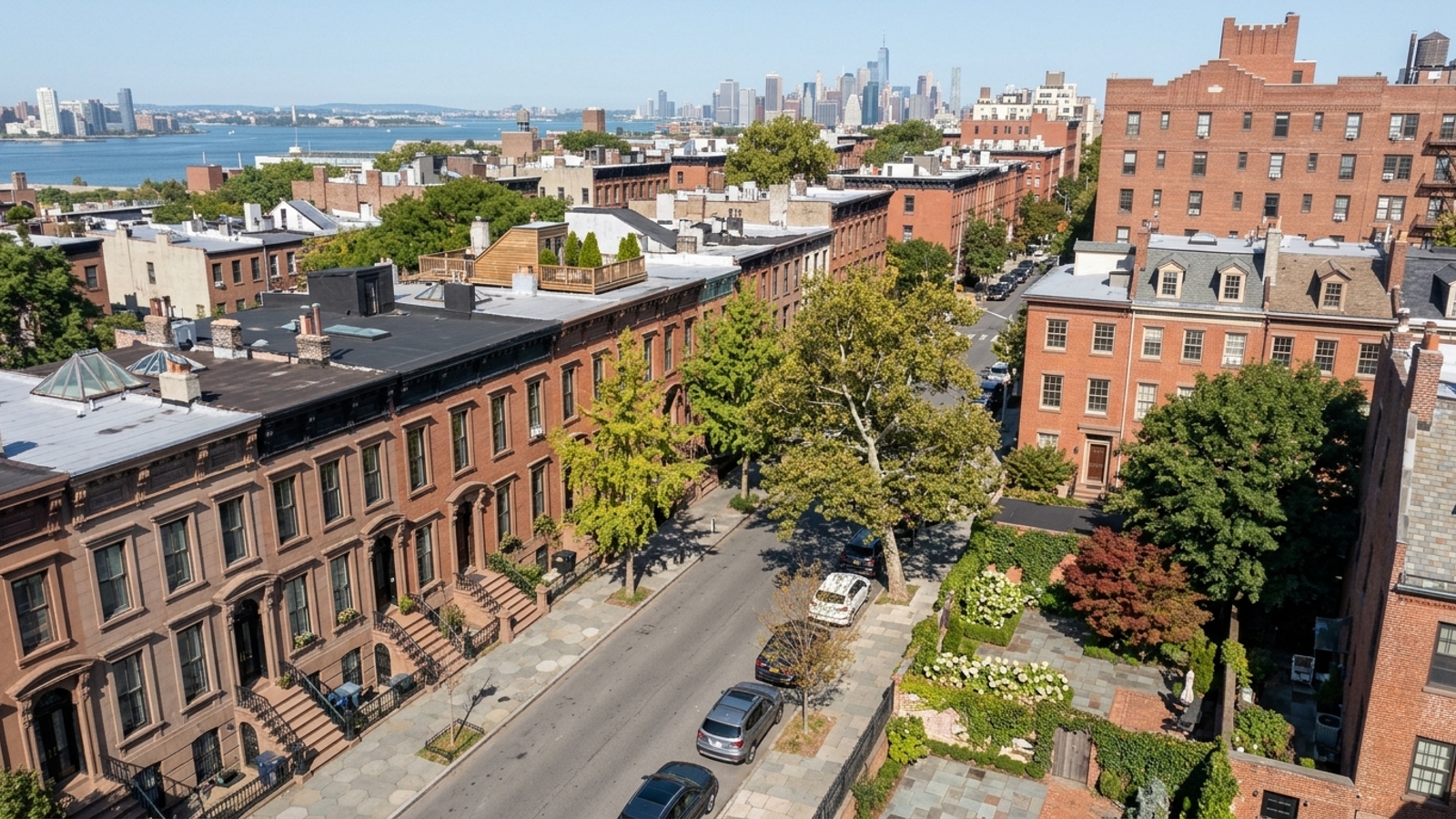
Brooklyn Heights is the oldest historic district in New York City, designated by the Landmarks Preservation Commission in 1965. Because the neighborhood’s boundaries from Old Fulton Street down to Atlantic Avenue are fully built out, finding an empty lot is practically impossible.
Key Takeaway
Ground-up construction is rarely an option in the built-out Brooklyn Heights historic district. The practical way to build a custom home is to buy a townhouse shell and gut-renovate it under city approvals. This route makes financial sense only if the shell price plus your total renovation budget comes in under the median price per square foot that homes recently sold for. If those numbers don’t align, renovating a condo interior is a faster and less expensive alternative.
Who This Guide Is For
You want a Brooklyn Heights home laid out to your own plans and are deciding whether to buy a whole building to renovate, update a condo apartment, or buy a finished property.
Can You Build a New Home in Brooklyn Heights?
Decades of landmark protection, a defining part of Brooklyn Heights history, have kept its blocks essentially completely built out. Buyers therefore look for existing properties to modify rather than land to build on.
Condos were 62 of the 69 sales in the 90 days ending September 30, 2026, and townhouse sales were too few to report. Whole buildings ready for a gut renovation are scarce, so be prepared to move fast when one lists.
Three Ways to Get a Home Built to Your Plans
Each route trades control of the building against upfront cost, agency approvals and construction time.
Gut-Renovate a Townhouse
Gutting a townhouse is the closest thing to building your own house in this neighborhood. You control the entire building and can reconfigure the interior to match your needs.
Every exterior change and permitted interior job runs through the Landmarks Preservation Commission. In a landmarked building, even interior work that needs a Buildings Department permit also needs a Landmarks sign-off.
Competition is real: about 39.6% of all homes sold above list price in the 90 days ending September 30, 2026.
Check one more thing before you bid. Many older townhouses are legally multi-family, and converting one to single-family use requires a new or amended certificate of occupancy. Ask the seller for the current certificate of occupancy and legal unit count before you make an offer.
Renovate a Condo Interior
A condo costs less up front than a whole townhouse, and the physical work stays inside your walls. That means much smaller exposure to landmark rules and usually a shorter timeline. Condos carry a $1,400,000 median sale price that remained flat over the past year.
You’ll need to work within the building’s alteration agreement, which governs work hours, insurance, architect reviews and deposits. Get that document from the managing agent before you sign a contract.
What you give up is total control. The board and the alteration agreement dictate what you can move, such as wet walls or structural elements, and you have no say over the facade, roof or common systems.
Buy Finished and Change the Finishes Later
Buying a home that’s already renovated lets you skip the approval timeline and move in much sooner. Later work can stay cosmetic, the kind that usually needs lighter permits or none at all.
The catch is that you pay full market price for someone else’s layout. Cosmetic changes rarely fix a floor plan that doesn’t suit your daily routine.
Build or Buy: The Cost Math in Brooklyn Heights
The local price per square foot gives you a benchmark for your renovation budget. Run this test before you bid on anything that needs major work.
Testing a 2,000-Square-Foot Plan
Buying 2,000 square feet of finished space in Brooklyn Heights runs about $3.08 million at the recent median. That’s the number a shell plus renovation has to beat.
To run the math:
- Start with the shell’s asking price.
- Add your hard costs per square foot.
- Add design, filing and approval fees.
- Add your carrying costs during the work.
If that total comes in under the finished-space figure, the renovation makes financial sense.
Renovation estimates often shift once walls and floors are opened. Ask your contractor what contingency they’d carry on an older townhouse and fold it in before you compare.
When Buying Finished Comes Out Ahead
Buying finished wins in three cases:
- Your all-in estimate lands at or above that finished-space total.
- You can’t carry two housing costs through construction.
- Your design depends on exterior changes the Landmarks Preservation Commission may not approve.
In a market where buyers routinely pay over asking, buyers rarely get a steep discount on the purchase price. Buying finished saves time but rarely leaves you money to put toward later changes, and you give up the chance to customize on your own budget.
How to Renovate a Home in Brooklyn Heights Step by Step
The steps run in order, and you can’t start demolition until the proper permits are issued. Confirm each one with your registered architect.
Check the Property’s Landmark and Zoning Status
Before bidding, look up the address on the Landmarks Preservation Commission’s Discover NYC Landmarks map to confirm its status. Then check the zoning district on the city’s ZoLa zoning map.
Brooklyn Heights falls within the SV-1 Brooklyn Heights Scenic View District. It restricts any building or structure from penetrating a defined view plane near the Promenade unless the City Planning Commission grants a special permit.
Zoning can also cap how much floor area you may add. A plan built around extra space may not be allowed, regardless of what you pay for the shell.
Hire a Registered Architect and a Licensed Contractor
The Department of Buildings requires a New York State-licensed Professional Engineer or Registered Architect to file construction plans and pull permits for the majority of construction. This professional acts as the applicant of record and guides your project through the city’s plan examiners.
Contractors doing home improvement work costing more than $200 on a residential property in New York City must have a Home Improvement Contractor license. Verify your contractor’s license on the Department of Consumer and Worker Protection license lookup before signing anything.
Design, filing and often expediter fees are paid months before any permit is issued. You lose that money if the real estate deal or the design falls through.
Get Landmarks Preservation Commission Approval
The Landmarks Preservation Commission issues different permit types depending on the scope of your work. Two are handled at staff level:
- A Certificate of No Effect covers work that needs a Buildings Department permit but doesn’t change protected architectural features.
- A Permit for Minor Work covers work that changes protected features but needs no Buildings permit.
Work that changes significant protected features and doesn’t meet staff-level guidelines needs a Certificate of Appropriateness. That’s the only permit type that requires a public hearing at the local community board and before the full Landmarks Commission.
A hearing adds time and can come back with required design changes. Ask your architect which permit route your plan is likely to need before you finalize a budget.
File for Department of Buildings Permits
After Landmarks signs off, your architect files the alteration application through the DOB NOW system.
Work that affects attached neighbors brings adjacent property protection duties under the New York City Building Code. The code requires specific protection for footings, foundations, party walls, roofs and chimneys during construction or demolition. On a block of attached row houses, that may mean you need access agreements with neighbors before work can start. Ask your architect when to approach adjoining owners.
Close Out Inspections and Sign-Offs
Once construction wraps up, your team must close all permits and complete the final inspections. That includes the new or amended certificate of occupancy if you changed the unit count.
Before buying any property, search the address in the Department of Buildings public records for open permits and violations left by prior owners. These stay with the property and can delay your own work or your eventual resale until they’re cleared.
What to Budget Beyond the Purchase Price
The shell price is only the first major expense in a gut renovation. Soft and hard costs start before construction does, and missing them can leave a project underfunded.
Renovation Hard Costs
Hard costs cover the materials and labor to build your home. You’ll need an architect’s estimate to set the price per square foot for your design and finish level.
Landmark-appropriate materials can push these costs higher than a standard renovation. Ask your architect whether the Landmarks Preservation Commission is likely to require specific window or facade materials for your address. Historic-district requirements can rule out cheaper stock products for anything visible from the street. That includes secondary facades that can be seen from a public thoroughfare.
Design, Filing and Approval Fees
Before a hammer swings, you’ll pay for an architect, a structural engineer, an expediter and city filing fees.
Department of Buildings filing fees vary by building type and scale with the estimated cost of the alteration. An Alteration Type 1 for a 1-3 family dwelling carries a minimum fee of $170 for the first $5,000 of cost, plus $2.60 per $1,000 above that.
Soft costs keep growing if the Landmarks Commission asks for revisions, because each round of changes means more design hours.
Closing Costs and Transfer Taxes
Residential sales in New York City are subject to city and state transfer taxes. Buyers also pay a mansion tax that starts at 1% for purchases of $1 million up to under $2 million and rises progressively for higher prices.
The median sale prices for both condos and all homes in Brooklyn Heights clear that threshold, so expect to pay it. It’s calculated on the full purchase price and paid at closing, which adds to the cash you need before renovation even starts.
Carrying Costs During Construction
While the house is unlivable, you pay property taxes and other parts of the cost of living in Brooklyn Heights, insurance, utilities in Brooklyn Heights and your current housing, all at the same time. Every month the approvals or the work run long is another month of paying for two homes.
Financing a Renovation Purchase
Some renovation mortgages, like the Fannie Mae HomeStyle Renovation loan, roll the purchase and renovation costs into one loan. These loans are capped at standard conforming loan limits. For a one-unit property in the high-cost New York City metro area, that limit is $1,249,125 for 2026. A standard purchase loan paired with cash, or a separate construction loan, is the other common path.
Renovation loans also have set draw schedules, and at Brooklyn Heights prices a large share of a gut renovation may still need to be paid in cash. Ask your lender how draws are released and what they cap before you choose a structure.
Brooklyn Heights Housing Market for Renovation Buyers
The median sale price for all homes recently reached $1,811,992, up 4.5% from a year earlier, while condo pricing held flat. The wider market is still climbing, while condo buyers face steadier prices.
With a median of just 35 days on the market and 2.9 months of supply, the Brooklyn Heights housing market leans strongly toward sellers. Line up your financing and get an architect’s feasibility read before you bid on a shell.
How to Decide Which Route Fits
The right route depends on your timeline and your budget.
- Do you need a whole building you control, or would a renovated floor-through apartment do? If a whole building, read the townhouse renovation section. If an apartment, read the condo interior section.
- Does your plan change the facade, roof, or rear of the building? If yes, budget time for the Landmarks Preservation Commission approval step and check the rooftop addition FAQ.
- Does your shell price plus renovation estimate beat what finished space sells for? Run your own numbers through the 2,000-square-foot test in the cost section.
- Can you carry two housing costs while a renovation runs? If not, read the carrying costs section and the section on when buying finished comes out ahead before you bid on a shell.
Choose by need:
- Townhouse shell: You need control of the whole building and your all-in estimate lands under the finished-space cost for the same square footage. It’s the only route that gives you the facade, roof and every floor.
- Condo interior: You want your own layout with less cash up front and a shorter approval path.
- Finished home: You need to move in soon or can’t carry two housing costs, or your renovation estimate tops the finished-space total. You’ll pay close to asking either way.
Reach out to a real estate agent in Brooklyn Heights to start evaluating your options and pricing a shell against finished sales.
At a Glance
- Median sale price, all homes: $1,811,992, up 4.5% year over year (90 days ending 2026-09-30)
- Median sale price, condos: $1,400,000, 0% change year over year (90 days ending 2026-09-30)
- Homes sold: 69 all homes, 62 of them condos (90 days ending 2026-09-30); other property types had fewer than 10 sales and aren’t reported separately
- Median price per square foot: $1,538 for all homes and $1,538 for condos (90 days ending 2026-09-30)
- Median days on market: 35 for all homes and 35 for condos (90 days ending 2026-09-30)
- Sale-to-list ratio: 100.2% for all homes and 100.2% for condos (90 days ending 2026-09-30)
- Share sold above list price: 39.6% of all homes, 40.7% of condos (90 days ending 2026-09-30)
- Months of supply: 2.9 for all homes, 2.6 for condos (90 days ending 2026-09-30)
- Active inventory: 66 all homes, 53 condos (90 days ending 2026-09-30)
Building a Home in Brooklyn Heights FAQs
Does Brooklyn Heights Flood?
Flood exposure varies by block, with lower-lying edges near the waterfront differing from the bluff-top interior. Check the exact address on the FEMA Map Service Center and the NYC Coastal Flood Hazard Mapper. Until new maps are issued, insurance rates follow the 2007 Effective FIRMs, while the building code uses the 2015 Preliminary Flood Insurance Rate Map for flood-resistant construction requirements.
Can I Legally Build or Renovate My Own House in New York City?
Yes, but a registered architect or engineer must file the plans for most major work. Some minor work needs no permit at all, and contractors must submit a Home Improvement Contractor license number on alteration permit applications.
Can You Tear Down a House in Brooklyn Heights and Build a New One?
Demolishing a building in a historic district requires Landmarks Preservation Commission approval, and any replacement building faces detailed design review. Ask an architect about the feasibility of a teardown before purchasing.
Can I Add a Floor or Rooftop Addition to a Brooklyn Heights Townhouse?
Staff-level approvals for rooftop additions in historic districts are generally limited to one story with a maximum height of 11 feet, set back from the front of the building with visibility restrictions. The Scenic View District’s view plane also sits roughly four feet above the Promenade.
How Long Does Landmarks Approval Take in Brooklyn Heights?
Staff-level permits move faster. A Certificate of Appropriateness adds public hearings at the community board and before the full Commission. Ask the Landmarks Preservation Commission for current review timelines for your project type.
Is $500,000 Enough to Renovate a Home in Brooklyn Heights?
That depends on the size of the home and your finish level. Divide $500,000 by your architect’s estimated per-square-foot hard cost to see roughly how many square feet it covers. Soft costs, filing fees and contingency come on top.
Can I Convert a Multi-Family Brownstone into a Single-Family Home?
Yes, once the Department of Buildings issues the new or amended certificate of occupancy that NYC Administrative Code §28-118.3.2 requires, generally filed as an Alteration Type 1 application. Confirm the current legal units and any tenancy status with the seller and an attorney before buying.
Sources
- Redfin: Data Center
- Historic Districts Council: Brooklyn Heights
- NYC Business: Performing Work on a Landmarked Property
- NYC Landmarks Preservation Commission: Additions Guidebook
- NYC Zoning Resolution: Special Scenic View District
- NYC Department of Buildings: Acquire Permits
- American Legal Publishing: NYC Administrative Code Alteration Fees
- American Legal Publishing: NYC Building Code Adjoining Property
- Gerard Law Firm: Certificate of Occupancy
- NYC Department of Buildings: Home Improvement Contractor License
- Prospect Places: NYC Mansion Tax Explained
- NYC Department of Environmental Protection: Flood Maps
- Fannie Mae: HomeStyle Renovation Fact Sheet